How does IMPALA see the role of sync evolving for independent labels across Europe today compared to five years ago?
Having distinct revenue sources is more important than ever, and sync offers many opportunities for labels and artists to expand the use of their music in interesting ways.
At 2.2% globally, sync still represents a relatively small share of the overall recorded music market, but revenue from sync is up year on year and we don’t see any good reason for sync to stop growing, given the huge number of quality shows, films, advertising and video games being produced. Europe has some catching up to do with the US, which is by far the largest market for sync, but that’s also positive in that it means there is huge potential, we “just” need to make sure more of Europe’s good music reaches the ears of music supervisors.
How do you see sync fitting into the bigger picture of fair remuneration for independent labels and artists?
We all know having your music synced – especially in a hit tv show, film or video game, or a big brand’s ad – can be a game changer in terms of revenue, and also popularity, especially for up and coming bands and artists, as well as for smaller labels. Again, all opportunities are vital and all uses should be fairly remunerated. IMPALA has done a lot in this area across multiple areas of exploitation, in particular streaming, public performance and broadcast, and AI licensing. Sync revenue is very important and should be well negotiated, including as regards what use of the music is covered by the licence. A piece of advice to labels: make sure you are not giving away absolutely everything and try to carve out AI uses!
What improvements are critical, and how do you see rights infrastructure evolving?
It’s essential to recognise the need to budget music as a key element of the overall work right at the start of a creative project, as something which will be vital to the success of the production. Sometimes music can be an afterthought or is done at the end when the budget is running low, which is a pity.
From your point of view, how can we protect creative work and artist income in a sync industry increasingly driven by cost-cutting and AI?
We are optimistic that good productions will continue to require good music synced within it. We are not anti-AI and there are lots of way AI assisted music can play an interesting role in sync, but we do believe that fully AI generated music is unlikely to resonate as well with the audience as art created by humans. Promoting the value of using human created music with real connections and feelings and a story behind it is much more compelling. In any case if music is fully AI generated it should also be licensed and generate meaningful income for the labels and artists whose music it was trained on.
We also need to make sure the right legislative framework is in place. This means making sure rules are respected and the commercial value of using a creative work is clear. Transparency and respect of copyright are key, and IMPALA is fighting to make sure European legislation delivers that.
What excites you most (and what concerns you) about where sync is heading?
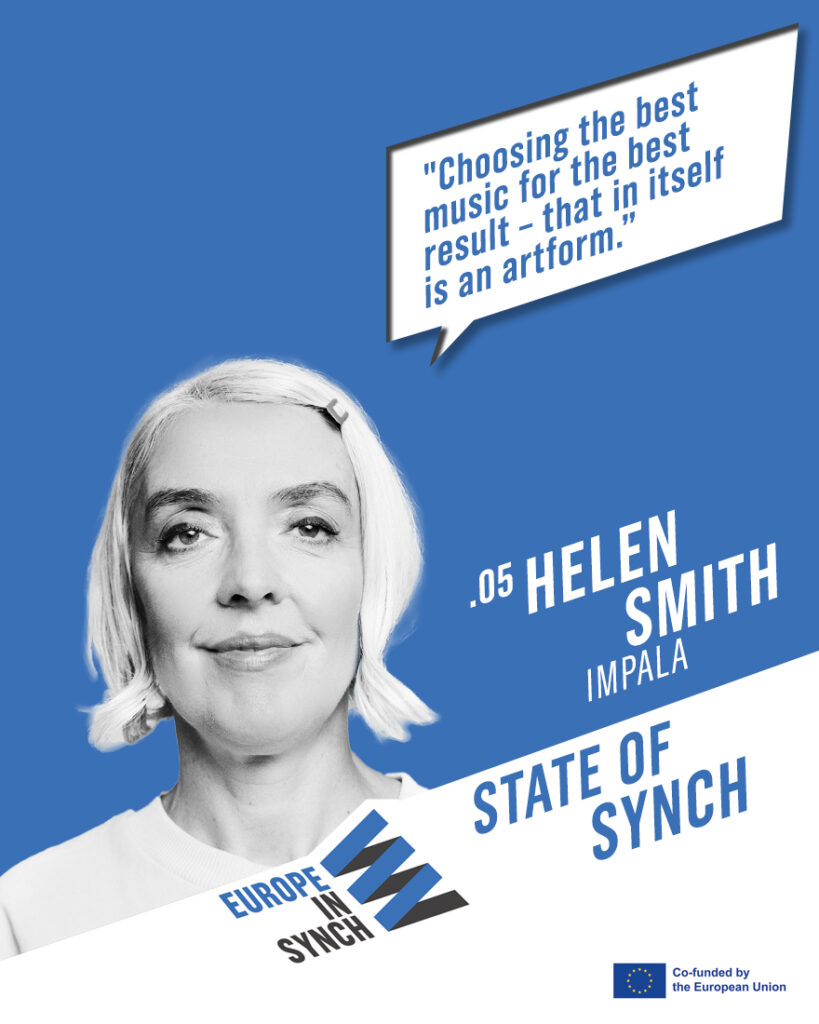
We are excited by the fact that there are more and more opportunities that transcend borders for labels and artists these days. Our concern would be the need for balance and making sure human creativity continues to be valued, and also the importance of choosing the best music for the best result – that in itself is an artform.
Originally from Scotland and based in Brussels, Helen Smith leads IMPALA, the European association representing thousands of independent music companies. Together with its board, she drives the organisation’s strategies on political, commercial, and promotional fronts — empowering independent labels and artists to leverage their collective strength. Her work spans key areas such as artificial intelligence, copyright, streaming reform, competition, sustainability, diversity and inclusion. Under her leadership, IMPALA has launched numerous action plans and awards schemes to strengthen the independent music ecosystem across Europe.