Estonia

1. General Introduction to Synch in Estonia

Estonia is a small country with a population of 1,3 million, which is naturally reflected in the limited size of the music industry and market. Furthermore, until regaining independence in 1991, the market was also fairly closed to international music industry trends and has resulted in relatively few companies specialising in music publishing beyond sheet music production and sales. Additionally, authors’ rights related to most synch uses (except for advertisements) have been represented by the Estonian Author’s Society (EAÜ), thus damping pressures from authors for more commercial representation through modern music publishing companies, including the negotiation of synch deals. The rights of performers are represented by the Estonian Performers Association (EEL) and the rights of (phonogram) producers are represented by the Estonian Association of Phonogram Producers (EFÜ).

Music publishing as a business has arguably been developing beyond rights administration and towards, among other things, finding creative opportunities for writers. The creation of audiovisual media and content has been growing and diver sifying, expanding the need for synching music. The Estonian music industry has become more international over the past 15 years, spurring new opportunities and needs concerning more contemporary music publishing and synch representation for Estonian music creators.
Over the past ten years, notably two companies specialising in music publishing in the contemporary sense, have been established. This has led to an increased emphasis on music synchronisation, fostering the growth of the synch market and unlocking the potential of Estonian artists and creators. The subject of synch has gained prominence over the past few years at industry events such as Tallinn Music Week, the Estonian Music Market’s Focus Day (Muusikaturu fookuspäev), and PÖFF Music Meets Film. Additionally, the topic has been extensively discussed with key stakeholders including the Estonian music export organization, Music Estonia, and one of the Estonian Collective Management Organisations, The Estonian Author’s Society (EAÜ).

1.1 Overall Synch Landscape

Commercially released music, in Estonia, is mainly licensed for film, TV and advertisements. There are also a few video game companies in Estonia, however, there is not a lot of collaboration between the gaming industry and music industry in terms of synch. Game developers, in Estonia and more generally, mainly use bespoke sound design or library music, rather than licensing existing tracks from artists1.

1| Based on interviews and conversations conducted by Virgo Sillamaa in 2018-2019 with the Estonian game developers community; and interviews with Jari-Pekka Kaleva and Konsta Klemetti in 2023.

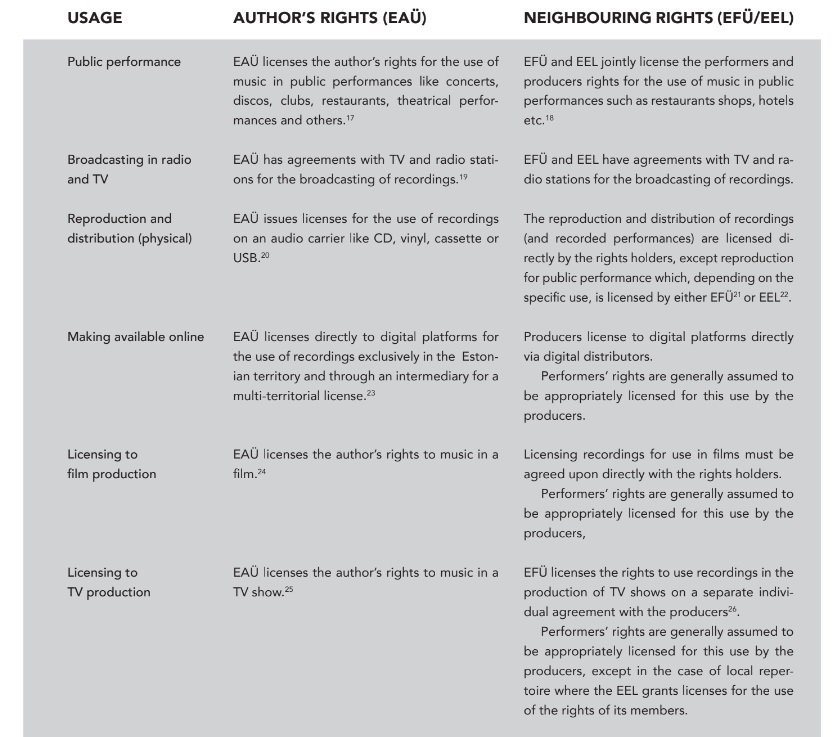
In Estonia, most synch licences for publishing rights can be obtained from the Estonian Author’s Society (EAÜ). In addition to the blanket licence for broadcasters, EAÜ also holds the rights to license their members‘ music into film and TV show productions. For the most part, master rights need to be licenced directly from the (phonogram) producers. There are a few exceptions, however, which will be explored in chapter 2.2.
Many professionals in the music sector, such as music publishers and the EAÜ staff, highlight a widespread lack of knowledge about synch licensing. This includes the understanding that you need to acquire two sets of rights, sometimes even three since it cannot always be assumed that the producer has all the needed agreements with the performers on the recording. Moreover, likely, many authors, artists and even producers do not know that publishing rights for most audiovisual media (except commercials) are controlled by EAÜ and not by the authors or publishers themselves (as is the industry norm in the United States and the UK).
2. Copyright & Synch Licensing

2.1 Copyright in Estonia

In Estonia, authors’ rights, neighbouring (or related) rights, including in relation to performers and producers, and the collective management of rights are regulated by the Estonian Copyright Act, in force since 1992. Estonia has been a member of WIPO and the Berne Convention since 19942, joining the WIPO Copyright Treaty and the Performances and Phonograms Treaty in 1997 (ratified only in 2009 and in force since 2010). Estonia is a member of the European Union since 2004. The international treaties and the EU membership mean that the copyright law in Estonia is similar to the rest of the EU countries, having, at the same time, certain specificities.

Estonian copyright law is grounded in the continental European droit d’auteur tradition and is characterised by the strong moral rights of authors and performers.

The Estonian Copyright Law states (§11 (2))4 that “the moral rights of an author are inseparable from the author’s person and non-transferable”5 and provides a catalogue of nine moral rights (§12 (1)), including – relevant from synch perspective – right to the integrity of the work, right to additions to the work, and right to protection of author’s honour and reputation. The Estonian Copyright Law thus provides protection of moral rights that goes beyond the minimum requirement of the Berne Convention.6 The author of a work is also guaranteed economic rights. The Copyright Law states (§13 (1)) that an author enjoys the exclusive right to use their work in any manner, to authorise or prohibit the use of their work by other persons and to receive income from such use. This exclusive right is only limited by the copyright exceptions provided by the law. This means that while the law proceeds to enumerate multiple economic rights, it is not a closed and finite list. The relevant economic rights to synch are the right to reproduction, distribution, alteration, public performance, communication of the work, and the right to make the work available on the Internet.

The Estonian Copyright Law also regulates related or neighbouring rights (chapter VIII). A producer (of phonograms) is defined as “a natural or legal person on whose initiative or responsibility a first legal recording of the sound arising from the performance or other sound occurs” (§ 69). Producers are granted only economic rights, including exclusive rights of reproduction (in any form or by any means), importation, distribution and making available of recordings (§ 70).

Performers are granted both moral and economic rights (§ 65). While the catalogue of performers’ moral rights is shorter than the authors’, it contains relevant rights for synch: the right of inviolability of the performance and the right of protection of the performer’s honour and reputation (§ 66). The exclusive economic rights include, among others, the right to record a performance for the first time, reproduce (either partially or totally), distribute or make recordings available online, and “use of the sound and image of the performance separately if they are recorded together and form a single whole” (§ 67).
In order to record performances, the producers are required by the law to obtain the prior written consent of the performers (§ 68 (1)), but in practice, written agreements outside more established music companies tend to be rare. There is a special situation concerning phonograms produced in Estonia before 1992: the master rights to these cannot be presumed to already contain the performer rights and permission should therefore be asked from the performers directly. The catalogue of phonograms produced by the Estonian Public Broadcasting before 1992 (including tens if not hundreds of thousands of tracks), for example, is not cleared for performers‘ rights which are represented by the performers themselves or by the Estonian Performers Association (EEL) .7

2.2 Collective Management Organisations in Estonia

2.2.1 Estonian Author’s Society (EAÜ)

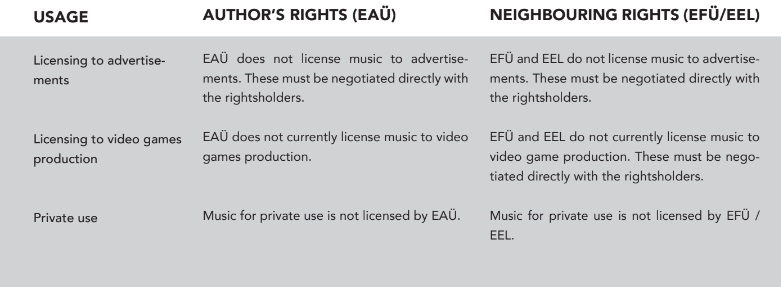
The Estonian Author’s Society was founded in 1991 and represents more than 6000 copyright holders from Estonia and 4 million copyright holders worldwide. EAÜ belongs to GESAC and CISAC networks, which bring together authors from 119 countries 8. With regards to synch, EAÜ licenses its members’9 works to various types of films (feature films, documentaries, short films) and TV programmes (broadcasting and VOD). The EAÜ does not issue licenses for using musical works in advertising. Such use must be conducted directly through the authors or their representatives10.
To obtain a synchronisation license from EAÜ, an application needs to be submitted via their website, upon which the EAÜ will issue an invoice and then the music can be used in an audiovisual work11.

The EAÜ 2022 Transparency Report details the types of licenses that EAÜ can grant users12:
• „public performance of works as live or technically mediated performance (public performance right);
• transmission, direct injection or retransmission of works via radio, television, cable network or satellite or via other technical equipment (the right of transmission, direct injection and retransmission);
• making works available to the public in such a way that persons can access the work from a place and at a time individually chosen by them, also via the Internet (right of making the work available to the public);
• recording works on sound or video medium, film or other similar medium or device and distribution of the work in such a manner (right of reproduction and synchronisation).”

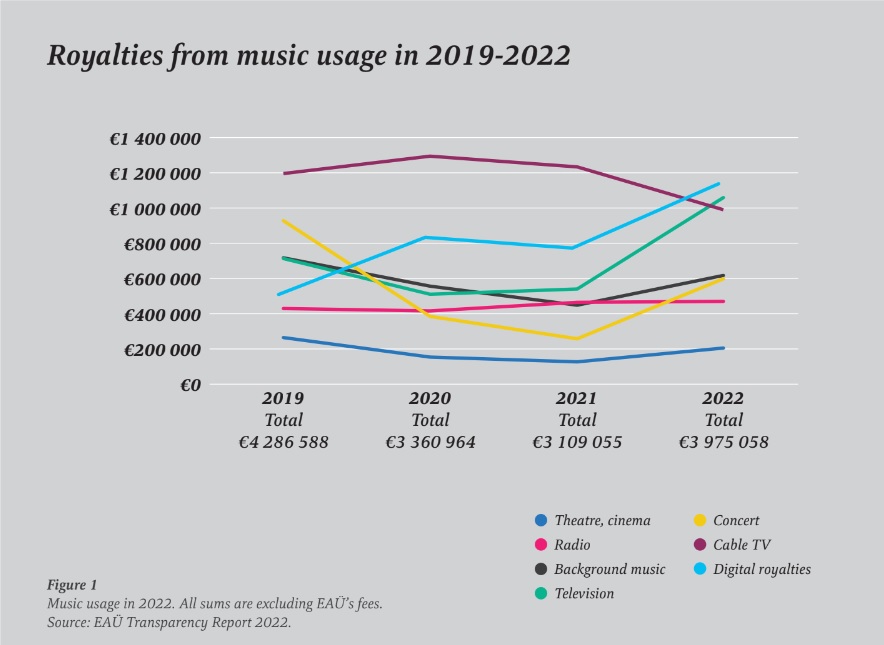
Figure 1 shows that the majority of EAÜs revenue from music licensing in 2022 came from Cable TV, followed by television. Important revenue sources are also licensing fees from reproduction rights, including recording and releasing music both physically and digitally, and making it available online (not shown on figure 1., but adding up to €1 134 973 in 2022)13.

The Estonian Author’s Society operates based on set licenses and tariffs for various categories of music usage in audiovisual works. The tariffs are based on the fee per second of usage and apply to the licensing of existing works. Regardless of the track, the fee per second remains the same. In the case of TV broadcasting, the fee also depends on the territories where the work will be shown.

2.2.2 Estonian Association of Phonogram Producers (EFÜ)

The Estonian Association of the Phonogram Producers (EFÜ) was established in 1998 and represents local and international phonogram producers in Estonia, distributing the remunerations from certain uses of recordings among their members and partner CMOs. EFÜ has bilateral agreements with other collective management organisations as well as being the officially appointed ISRC Registration Agency for Estonia by the International Federation of the Phonographic Industry (IFPI).14

EFÜ acts as a mediator between the master rights holders (phonogram producers) and music users when it comes to the public performance of recordings in various public spaces like nightclubs, restaurants, hotels, etc. The organisation also gives out a blanket license to TV and radio stations for using recordings for broadcasting. EFÜ does not give out licenses for film, advertisement, or VOD content producers. These must be negotiated directly with the master rights holders. However, there are exceptions regarding broadcasted TV programmes. Members have the option to grant EFÜ the right to represent the master rights of their recordings for use as background music in TV programs. It‘s important to note that this authorization specifically pertains to background music in TV programs and doesn‘t extend to theme songs or title songs. Negotiations for the latter must be conducted directly with the respective rights holders.15

2.2.3 Estonian Performers Association (EEL)

The Estonian Performers Association (EEL) was established in the year 2000 and it represents and administers the rights of performers in Estonia. The EEL does not typically administer licenses for synch usage since these rights are usually held by the phonogram producers. The exception is for phonograms recorded earlier than 1992 as this was before performers were able to sign their rights to be represented by phonogram producers. Over the last 10 years, phonogram producers have started paying more attention to signing accurate contracts with performers. In the case of recordings made before 1992, the necessary conditions were often not agreed upon.

Therefore, in many cases, phonogram producers do not have the right to grant permission for the performer to use the corresponding rights.

2.3 Synch Rights and the Role of Collective Management

The Estonian Copyright law does not regulate or mention specifically synch rights as such and a synch contract essentially bundles a set of rights needed for specific synch usage (such as using the piece of music in a film, TV series, etc.). In case the rights to adaptations, modifications (arrangements) and other alterations of the work are sought as part of the synch contract, it must be kept in mind that in addition to the relevant economic rights, the use of moral rights is involved as well (i.e. the integrity of and additions to the work, and right to protection of author’s honour and reputation). While the moral rights are inalienable and cannot be assigned, an exclusive or non-exclusive license can be issued whereby the author allows others to use their moral rights16. Similarly, the performer’s moral right to the integrity of performance might be touched when the master rights are being cleared for usage that includes adaptations, etc. Care should be taken to check whether the person or organisation licensing the master rights has also cleared performer rights adequately.

The CMOs (EAÜ, EFÜ, EEL) collect royalties for most types of public performances of audiovisual works that have music synched (licensed) for it, including cinemas, TV (re)broadcasting and online platforms. The exception is that, in contrast to some other European countries, the Estonian CMOs do not collect royalties for the public performance of advertisements.

2.4 Synch revenues from licenses granted by collective management organisations

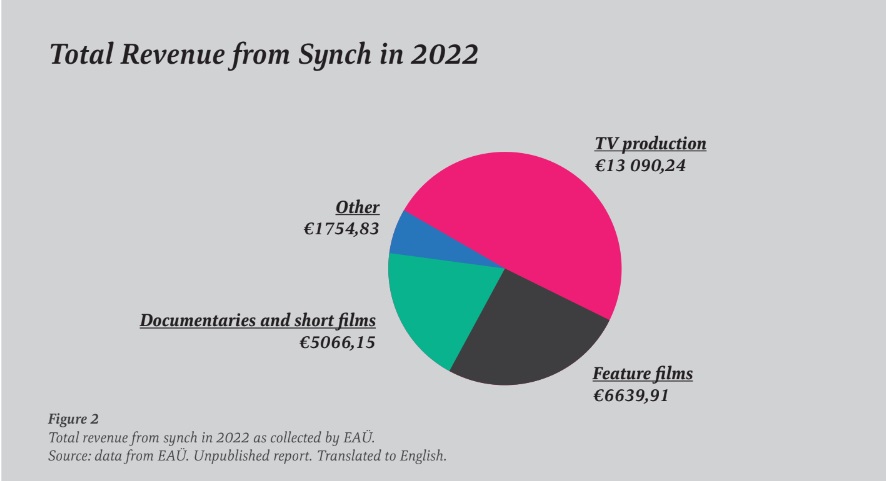
Many synchs for film, television and other uses are processed through the Estonian Author’s Society, making their invoicing records a key resource for understanding the market. In 2022, the Estonian Author’s Society (EAÜ) issued synch invoices totalling €26 551,13, with €18 902,39 being paid out to authors. The breakdown of these invoices was as follows:

• €13 090,24 (€9 259,02 for authors) came from TV
• €6 639,91 (€4 742,79 for authors) came from feature films
• €5 066,15 (€3 646,15 for authors) came from documentaries and short films
• €1 754,83 (€1 254,43 for authors) was from other uses (video clips, company programmes, cultural announcements etc.)27

Figure 2 shows the revenue EAÜ collected from synch in 2022 and the categories where the majority of the revenue came from. The first being TV productions, followed by feature films, documentary films and lastly by other uses.

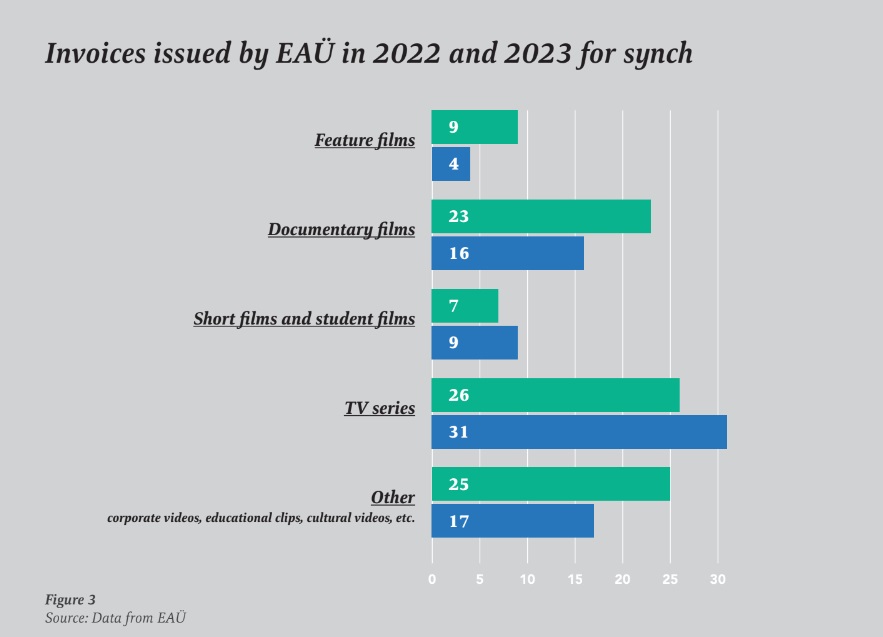
Data from EAÜ reveals that in 2022, they issued invoices for a total of 90 sync projects. Among these, 9 were related to feature films, 23 to documentary films, 7 to short films and student films. Additionally, 26 projects were connected to TV series, primarily involving TV3, ERR, Kanal 2, and including Viaplay and Inspira. The remaining 25 invoices covered a variety of other categories, such as corporate video clips, educational videos, cultural videos, and more.

Data from 2023 shows that there were more invoices issued by the EAÜ for the use of music in TV series than in 2022. There were fewer invoices for the use of music in feature films, documentary films and in the category “other”.
EAÜ can only license and issue invoices for songs that they represent. According to Mati Kaalep, the CEO of EAÜ, they also receive requests for songs that are from foreign authors. In this case, it depends on whether the CMO representing those authors is also authorised to license synch uses or not. In the latter case, EAÜ can only help out with finding the right contacts and the music users will have to get in touch with the publishers and labels directly. Additionally, some of the requests are submitted on the websites, and some via email. TV stations will often license the music after they’ve already used it and they oftentimes have a blanket license for which they pay a monthly fee, allowing them to use songs from EAÜs repertoire.

Data from the Estonian Association of Phonogram Producers (EFÜ) shows that in 2022, the organisation collected a total of €19 519 (14 639 for producers) for the use of recordings in TV programmes (mentioned in chapter 2.2.2), which made up just 1,8% of its yearly revenue.28

3. Music Users & Market Opportunities

The music users in Estonia can be divided into several main categories: film production firms, advertising and media agencies, video game developers, TV broadcasters and VOD channels, and other music users (for example podcasters, creators of corporate videos, etc). The following chapter will provide an overview of each category, highlight the main actors and present the available data on how many projects are produced per year, thus showcasing the potential market opportunity for synch.

3.1 Film Production Firms

The film industry in Estonia is on the rise, with local productions in recent years earning international awards and Estonia establishing itself as a filming location.
The Black Night’s Film Festival (PÖFF) has also been acknowledged as an A-category film festival29 and the Estonian film school Baltic Film and Media School is also well-regarded in the region for its education and production facilities.

There are several film and TV production firms that work on both local and international projects and often collaborate with other European or international studios.

The Estonian Film Institute (EFI) has a list of production companies in Estonia. Many of the companies are small and operated by one or two people. Out of the larger companies, some notable examples include:

Allfilm
Nafta
Baltic Film Production
Cuba Films
Get Shot Films
Homeless Bob Production
Stellar Film
Taska Film
Amrion
ExitFilm
Alexandra Film
Filmivabrik

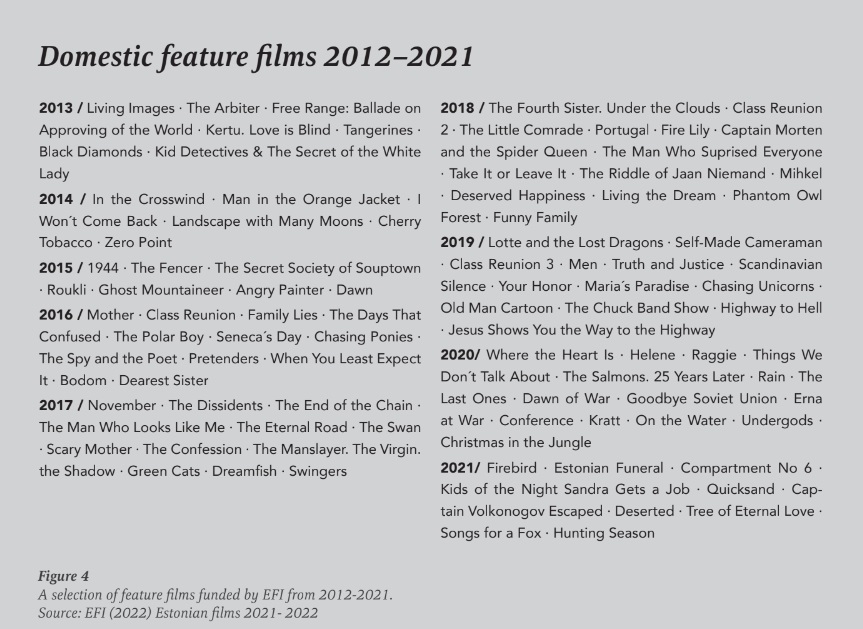
Data on the total number of films produced each year is unavailable and currently, only the number of films that have received funding from The Estonian Film Institute is known. EFI’s annual film catalogues can be found here. These catalogues give an incomplete overview of the films produced each year, the company that produced them and all actors involved including composers, sound engineers, producers etc. These catalogues are incomplete as they were put together for the purpose of presenting films to film festivals and not for providing a complete picture of the Estonian film market.

The institute has also created a production guide aimed towards foreign film producers looking at Estonia as a potential filming location. The guide has information on all the major Estonian production companies.

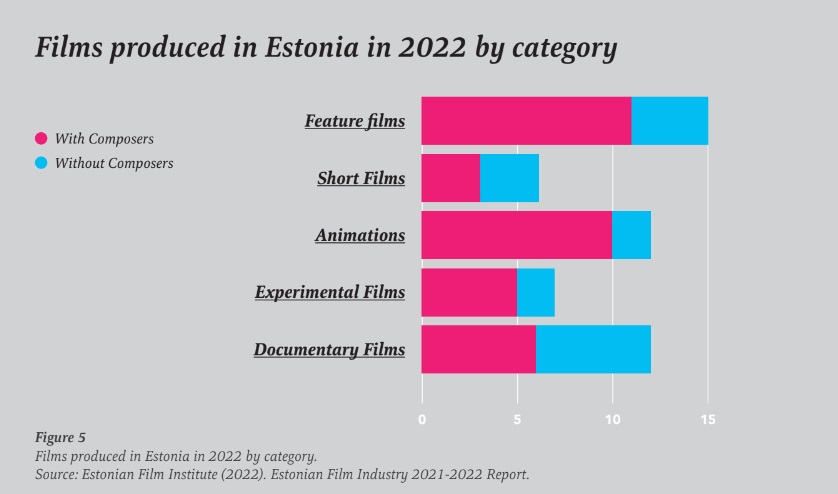
The annual number of films receiving funding from EFI remains in the double digits. In 2022, a total of 52 films, spanning feature films, documentaries, short films, animations, and experimental films, secured funding. Among these, 35 films had a dedicated composer working on the score. Notably, 26 films collaborated with composers from Estonia and 8 with international composers.30

Figure 6 provides a partial overview of the number of funded feature films, short films, animations, experimental films, and documentaries produced in 2022, along with the corresponding information on their collaborations with composers. It‘s important to note that the data is incomplete due to the exclusion of films that received private funding, which are not accounted for in these lists.

3.2 Advertising and Media Agencies

Advertising and media agencies are a major source of synch revenue and an important music user group. The advertising industry in Estonia is quite substantial for a small market and there are numerous advertising agencies that work with companies and brands to create ads for TV, social media, and video. Many of these agencies are also part of the Estonian Marketing Association (TULI). Some notable local advertising agencies include:

DDB
Division
Tank
Taevas Ogilvy
Newton
La Ecwador
Optimist Creative

Syrr
Salama Creative Agency
Zavod BBDO
MegaPixelStuudio
Creatum

It is important to note that the agencies are not the final client and thus they may not always have the final say on which music is used. However, they are involved in finding, suggesting music, and clearing rights.

Some companies can also produce advertisements or video content needing music in-house, and in those cases, it would be a creative director, marketing manager or someone in the creative/marketing/communication team who will be involved in choosing the music and negotiating the license.

Determining the number of ads produced per year in Estonia is no easy task since there is no unified database where that info would be readily available. The marketer’s association (TULI) does not possess such data and neither does the author’s association (EAÜ) since sync licenses for advertisement are not negotiated through EAÜ but directly between the artists and the advertising agency. Hence, data on the number of ads produced, how many of them license music from artists or commission bespoke music, and what the market opportunities are, remains limited.

3.3 Video Game Developers

The video game industry is rapidly growing globally and there is a demand for music and audio. The industry is fast-moving and tech-savvy and has found ways to license and commission music globally independent of the collective management agencies. Game development companies, depending on their size and budget, typically use music libraries, audio asset stores (like Unreal Engine and Unity) and AI-generated music to add an audio component to the games. Larger studios may also have an in-house composer or commission scores from video game composers or game audio companies. These are usually commissioned on a buy-out basis and not registered at the collective management organisation. Composing for video games requires a strong collaboration between the composer and game developer and it is usually necessary for the composer to understand the intricacies of game development. The market operates rather self-sufficiently and licensing existing tracks from artists is only done rarely, and usually from big-name artists.31

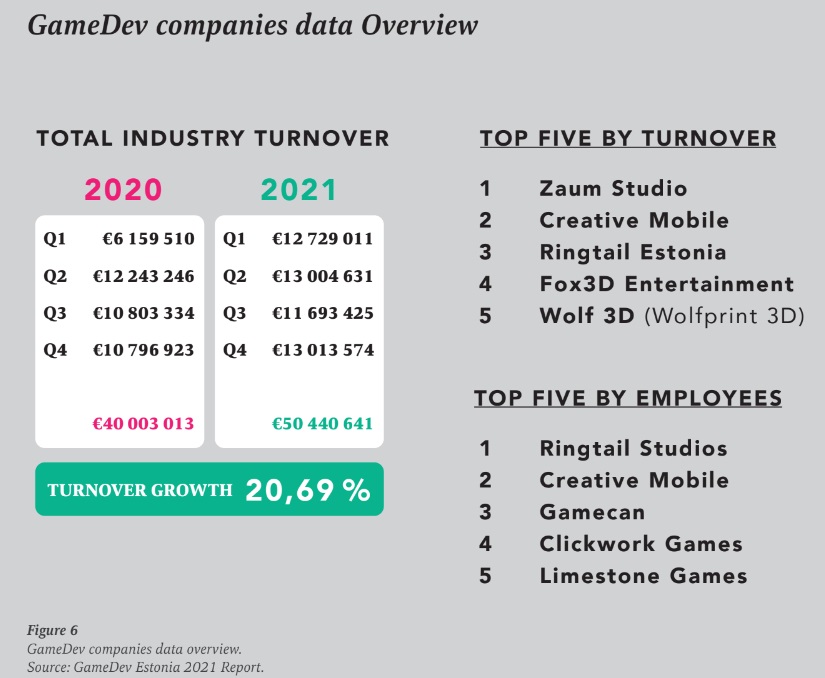
There are around 40 active game developers in Estonia and around 800 gaming industry professionals32. A full list of all the companies can be found on Game Developer’s Estonia’s website. Many of the companies are small with one or two employees.

Similarly to many European Collective Management Organisations, the Estonian Author’s Society (EAÜ) does not collect royalties from video games nor do they administer licenses for music usage in games.

Game development companies in Estonia with the largest turnover and/or highest employee count include the following:
ZAUM Studio
Ringtail Studios Estonia
GameCan
Limestone Games
Playflame
Placeholder Gameworks
CM Games/Creative Mobile
Fracture Labs/Decimated

More information on the Estonian gaming industry can be found on Game Development Estonia’s website as well as in a 2021 report on the Estonian game market. Another excellent source for information on the gaming industry is the European Game Development Federation.

Overall, the game industry in Estonia presents an untapped opportunity for composers and musicians ready to explore that world in depth and build direct connections within the industry.

3.4 TV Broadcasters and Local Video-on-Demand Channels

The production of TV series and the use of music for TV programmes provides another opportunity for synch. The main TV channels in Estonia that use music include ETV, Inspira, All Media Eesti (TV3, GO3), Duo Media Networks, Elisa and Kanal 2 amongst others. These channels typically have blanket license agreements in place with the Estonian Author’s Society (EAÜ) and the Estonian Association of Phonogram Producers (EFÜ) to cover the music for content broadcasted in Estonia.

There are a few TV broadcasters who produce original content and license music from artists and commission composers to create original music.
ERR
TV3 (under All Media Eesti)
Elisa HUUB Original Series
Jupiter (under ERR)
ViaPlay
GO3 (under All Media Eesti)

TV series are typically created by production firms and as far as it is known, there are no dedicated professional music supervisors. Rather, the music is chosen by editors, sound designers, and/or directors and the licenses are typically obtained by the producers. The main production firms that create TV series in Estonia include
the following33:
Ruut
Kassikuld
Thors Production

As with advertising, getting any kind of data on the number of series produced each year and how many of those licensed music from artists or commissioned composers, is challenging. There is no unified database and obtaining the information from the channels directly is difficult.

4. Rights Holders and Music Providers

As a small and still developing music ecosystem, most creators and artists are self-published and self-released. Currently, EAÜ represents most of the synch rights for authors for film and TV. However, the music publishing industry is starting to develop and the overall knowledge and interest in synch is increasing.

4.1 Music Publishers

None of the major publishers, Warner Chappell, Universal Music Publishing Group, or Sony Music Publishing are present in Estonia and the region is overseen by Sweden since it is the nearest country with major publishers. As the sector and tradition of music publishing is still relatively young in Estonia, the majority of authors are self-published and represented by the collective management organization, EAÜ. However, in recent years, several Estonian authors have worked with publishers from abroad (mainly Finland). There are, however, two independent music publishers that were both set up in the last three years – FAAR Music and Tier Music. FAAR Music represents a dozen writers/producers and Tier represents a little under ten. Tier Music has also worked on developing a sync agency side, where they represent a dozen local artists for synch both in Estonia and abroad. There are also a few companies that are developing 360 agencies with a publishing side, so there will likely be more independent music publishers in Estonia in the near future. Last year, the Estonian Music Industry Awards also created a new category for Publisher of the Year, which will hopefully help raise awareness of music publishing in Estonia. A few Estonian authors and composers are also represented by publishers abroad.

4.2 Record Labels

All three major labels, Warner Music, Universal Music, and Sony Music, are present in Estonia and represent local artists as well as their international catalogues. Universal Music, Sony Music and Warner Music do not as of now have a legal entity in Estonia and are essentially affiliates of their Finnish offices. Sony Music Entertainment Finland launched a co-venture in 2019 with Estonian management Made in Baltics forming Made in Baltics Entertainment.

There are also a few independent record labels. Some notable ones include:
Estonian Funk Embassy
TIKS Rekords
Õunaviks
Legendaarne Records

Two independent labels also work closely with majors: SMUUV Records with Warner Music and Made in Baltics with Sony Music.
All these labels are naturally involved in the clearance process of synch licensing and some independent labels are also working on developing their synch reach by pitching their music to music users, attending conferences and workshops as well as being in contact with music supervisors abroad.

4.3 Composers

There are several composers who work on writing scores and soundtracks for both domestic and international films, TV series and advertisements. Many of the composers work independently with film/TV/advertisement directors/producers and do not have an agent promoting them and their work. It is also quite typical for directors and composers to establish a long-lasting working relationship and work together on multiple films. Since Estonia is quite small, the directors will usually know most local composers or they’ll be recommended to them through word of mouth.

The Black Night’s Film Festival’s (PÖFF) Music Meets Film programme also provides an opportunity for film composers to network, learn and meet new collaboration partners.
Estonian Film Database contains a list of Estonian film composers: Filmmakers – Composers.

4.4 Other Actors Involved in Sync

There are also other companies involved in synch in Estonia that do not fall under the categories mentioned above. For example, music libraries. The most widely used music library is Apollo Music, a Danish company that also has an Estonian office. Besides Apollo Music, music users also license from international music libraries like Artlist and Epidemic Sound, to name a few.

Another company, Royal Mystery, also acts as a mediator between the audiovisual producers and session vocalists, working with specific briefs for advertisements and adding vocals to songs. Likewise, there is MySound, a music library that provides stock music for companies to use.

5. Finding and Clearing Music

As with many smaller synch markets, there is no tradition of having music supervisors or synch agents. As of now, there are no official professional music supervisors in Estonia, although sometimes composers or film producers have taken on that role by “accident”. In terms of synch agents, there are now a few companies that work more closely with this such as Tier Music, FAAR Music, or Made in Baltics, amongst others.

If there are no music supervisors in the market, who is the person on the side of the film, TV show, or advertisement who searches for the music, chooses the music, drafts the contracts, and clears the rights? To answer this question, two smaller research studies were conducted in the past two years – one with advertising agencies and one with film production studios.

5.1 For Advertisements

The study on advertising agencies conducted by Silvia Käsk and Anni-Marie Rea in 2021 gathered information from 30 advertising professionals.34 The job titles of the participants were mainly creative directors, project managers, marketing managers, and producers. According to the participants, someone from the advertising agency (usually the creative director or producer) will suggest potential tracks to the company that commissioned the ad and the brand director of the company will get the final say. Rights are then cleared by the advertising agency35.

The music for advertisements is often found in music libraries such as Apollo Music, in the case of using library music, or on streaming platforms (Spotify, Youtube), in the case of using licensable tracks. The advertising industry in Estonia tends to use music from music libraries due to it being cheaper and more convenient and to there not being a long-lasting tradition of synch.

5.2 For Film

A small study recently explored the use of music in Estonian films36 focusing on who is in charge of finding, choosing, and clearing music; at which stage of the project; how and what the budgets are.37

According to the study, film producers are the main people who deal with licensing music for film. Commissioning bespoke music is however done either by the director or producer. Rights are typically cleared by the producers who will usually try to get in touch with the artist themselves or their manager. Sometimes producers will try to reach out to labels or publishers in order to find music or clear rights. For film, authors’ rights can also be handled and cleared by the collecting society EAÜ.
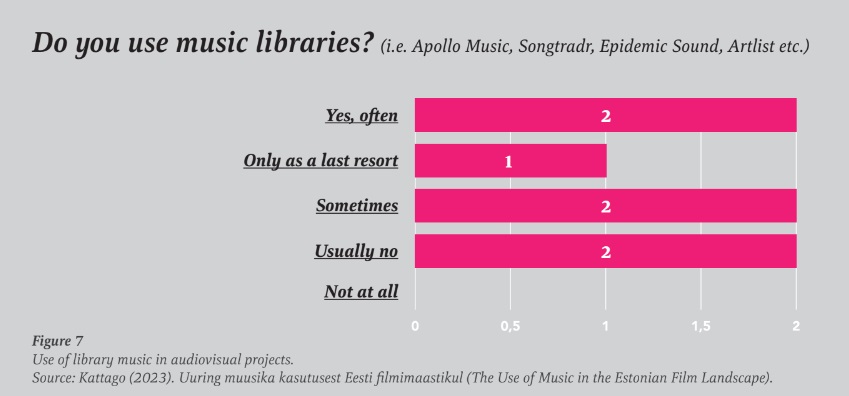
Like with advertisements, music is usually searched for in music libraries or on streaming platforms like Spotify and YouTube. The use of music libraries however tends to be smaller for films than for ads. During the interview, it was stated that it is more of a last resort if the film producers cannot find any licensable music within their budget. Previous conversations with film professionals have also echoed this sentiment saying that they prefer synched tracks or original music over library music and try to accommodate this as much as possible.38

In this study, film professionals also stated that they preferred to use music by Estonian artists when possible both because it is easier to obtain the licenses and to support Estonian music. However, since films can sometimes be co-produced with other European countries, then the filmmakers might need to choose a composer, or music from the other country.

6. Typical Synch Budgets

6.1 Typical advertising budgets and percentage allocated to music

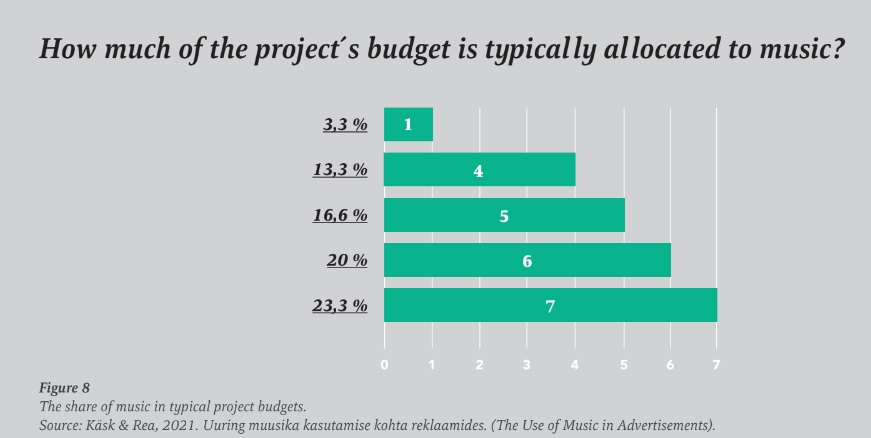
It is quite challenging to determine the typical advertising budgets in Estonia as they can vary quite a lot depending on the brand, type of ad, etc., and can be confidential. The study conducted by Käsk and Rea39 asked the question of what percentage of the total budget for an ad is allocated to music (see Figure 9) and the responses indicated that 43.3% spend less than 5% of the total budget of an ad on music. For 10% of respondents that amount was 5-10%. 13.3% spend 10-20% and for 13.3% it depends. This mirrors anecdotal knowledge in the Estonian synch industry that typical budgets for music in advertising are quite small. This can range anywhere from €100-€10 000 .40

6.2 Typical film budgets and percentage allocated to music

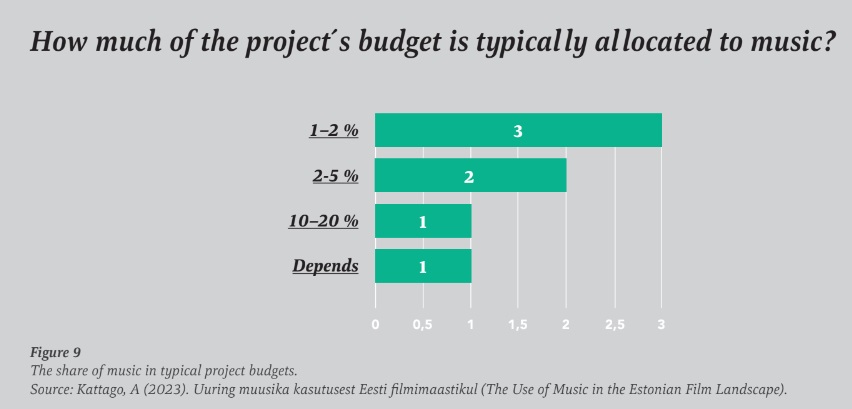
The study of the usage of music by film professionals41 showed that out of the 7 respondents, 42.9% spent around 1-2% of the total film budget on music and 28.6% between 2-5% and 14.2% 10-20%. One person responded that if they are using a music library, then they’ll spend 1-2% and if they are licensing an existing track directly from rights holders, then they’ll spend 10-20%. Naturally, since this study was small, it is not representative. However, based on other observations, it seems likely that the part of the film budget allocated to music is typically below 5%.
Film budgets in Estonia are often public and part of larger European cultural funds.
Additionally, production firms often collaborate with other European filmmakers.

7. Summary

Overall, the Estonian sync market is experiencing steady growth, evolving in tandem with the music publishing industry. An increasing number of music companies, including labels and managers, are progressively exploring and embracing sync opportunities, both domestically and internationally. Nevertheless, owing to Estonia‘s relatively small market size, film production studios and advertising agencies often operate with limited budgets for music, resulting in frequent reliance on music libraries. Furthermore, due to the sync market being relatively new, there is no established structure of music supervisors, making it difficult to know who to reach out to and who is in charge of music selection and clearance. Likewise, the level of knowledge on music synchronisation, copyright and licensing is still relatively low, however, it is improving due to increasing opportunities to gain formal education and informal training about the music business, and several campaigns related to raising awareness on copyright and intellectual property in general.

References

Eesti Autorite Ühing (2023a). About us. Available at: https://eau.org/en/about-us/or-ganisation/estonian-authors-society/

Eesti Autorite Ühing Website (2023b). Use of Musical Composition in an Audio-visual Work. Available at: https://eau.org/en/for-the-user/use-of-a-musical-compositi-on-in-an-audiovisual-work/

Eesti Autorite Ühing (2022) Transparency Report for 2022. Available at: https://eau.org/wp-content/uploads/EAU-labipaistvusaruanne-2022-ENG.pdf

Eesti Esitajate Liit (2024). Üldinfo. Available at: http://www.eel.ee/et/eel/uldinfo/

Eesti Fonogrammitootjate Ühing website (2023). About us. Available at: https://www.efy.ee/en/about-us/

Eesti Fonogrammitootjate Ühing (2023). Eesti fonogrammi tootjate ühingu 2022 aasta läbipaistvusaruanne. (The Estonian Association of Phonogram Producers 2022 annual transparency report). https://www.efy.ee/wp-content/uploads/2023/05/
efu-2022-aasta-labipaistvusaruanne.pdf

Estonian Film Institute (2022). Estonian Films 2021-2022. https://filmi.ee/wordpress/wp-content/uploads/2022/02/EFI_filmiraamat_2022_150.pdf

Estonian Film Institute (2023). Production Guide Estonia https://filmi.ee/wordpress/wp-content/uploads/2023/01/EFI_Prod_guide_2023.pdf

European Parliament (2018) Copyright Law in the EU: Salient features of copyright law across the EU member states. European Parliamentary Research Service.

GameDev Estonia (2022). The Game Industry of Estonia 2021. https://gamedevesto-
nia.ee/gamedev-industry-2021/

Kattago, Alice (2023). Uuring muusika kasutusest Eesti filmimaastikul. (The Use of Music in the Estonian Film Landscape).

Käsk, Silvia & Rea, Anni-Marie (2021). Uuring muusika kasutamise kohta reklaamides. (The Use of Music in Advertisements).

Pisuke, H (2002). Moral Rights of Author in Estonian Copyright Law. Juridica International VII. Pages 166-175. Available at: https://www.juridicainternational.eu/public/pdf/ji_2002_1_166.pdf

The Constitution of the Republic of Estonia. Available online at: https://www.riigi-teataja.ee/en/eli/530122020003/consolide  WIPO (2023). WIPO-Administered Treaties. https://www.wipo.int/wipolex/en/treaties/ShowResults?code=EE

1| Based on interviews and conversations conducted by Virgo Sillamaa in 2018-2019 with the Estonian game developers community; and
interviews with Jari-Pekka Kaleva and Konsta Klemetti in 2023.
2 | Technically, Estonia joined already 1927, but this lost validity after the Soviet Union occupied Estonia between 1940 and 1991.
3 | WIPO (2023). WIPO-Administered Treaties. https://www.wipo.int/wipolex/en/treaties/ShowResults?code=EE
4 | Riigi Teataja. Copyright Act. § 11 (2) https://www.riigiteataja.ee/en/eli/ee/519062017005/consolide/current
5 | The same principle is enforced also by the Consitution (§39): “Authors have the inalienable right to their creative works. The state shall protect the rights of authors”. The Constitution of the Republic of Estonia. Available online at: https://www.riigiteataja.ee/en/eli/530122020003/ consolide.
6 | Pisuke, H (2002). Moral Rights of Author in Estonian Copyright Law. Juridica International VII. Pages 166-175. Available at: https://www.juridicainternational.eu/public/pdf/ji_2002_1_166.pdf
7 | This is regulated by the Copyright Law § 88 section 1: The Copyright Act also extends to works and results of the work of performers, producers of phonograms or broadcasting service providers which are created before 12 December 1992.
8 | Eesti Autorite Ühing (2023a). About us. Available at: https://eau.org/en/about-us/organisation/estonian-authors-society/
9 | In some cases, EAÜ can represent for synch uses also the rights work by international authors. This depends on whether the CMO of another country with which EAÜ has a bilateral agreement with is also represents their members’ rights for synch uses or not.
10 | Eesti Autorite Ühing Website (2023b). Use of Musical Composition in an Audiovisual Work. Available at: https://eau.org/en/for-the-user/use-of-a-musical-composition-in-an-audiovisual-work/
11 | Ibid
12 | Eesti Autorite Ühing (2022) Transparency Report for 2022. Page 16 Available at: https://eau.org/wp–ontent/uploads/EAU-labipaistvu-saruanne-2022-ENG.pdf
13 | Ibid, page 15.
14 | Eesti Fonogrammitootjate Ühing website (2023). About us. Available at: https://www.efy.ee/en/about-us/. Also IFPI website (2023). Natio-
nal Agency Contacts. Available at: https://isrc.ifpi.org/en/contact/national-agency-contacts
15 | EFÜ website (2023). Available online (in Est): https://www.efy.ee/wp-content/uploads/2023/01/telesaadete-helindamise-tingimused.pdf
16 | Pisuke, H (2002). Moral Rights of Author in Estonian Copyright Law. Juridica International VII. Page 175. Available at: https://www.juridicainternational.eu/public/pdf/ji_2002_1_166.pdf
17 | …
18 | EFÜ and EEL license neighbouring rights for public performance jointly and it is sufficient to obtain a license agreement from one of them. EFÜ and EEL split the accruing fees equally for producers and performers. See more (in EE): http://www.eel.ee/wp-content/uploads/2017/10/EF%C3%9C_buklett_2017.pdf
19 | EAÜ website (2023). For the User: Transmission and Retrasmission. https://eau.org/en/for-the-user/transmission-and-retransmission/
20 | EAÜ website (2023). The Use of a Musical Work on an Audio Carrier. https://eau.org/en/for-the-user/use-of-a-musical-work-on-an-audio-carrier/
21 | EFÜ licenses the reproduction of recordings for public performance, use by DJs and in jukeboxes, etc. See for more info (in EE): https://www.efy.ee/reprodutseerimine/
22 | EEL licenses the reproduction of (performances on) recordings for public performance in various cases (see
here (in Est): http://www.eel.ee/et/muusika-kasutajad/fonogrammide-avalik-esitamine/). For music licensees operating in transport, catering, hospitality, night club or casino management will obtain the reproduction license from EFÜ and this includes the performers’ rights as well. No separate license agreement with EEL is needed (see the link above).
23 | EAÜ website (2023). Online use of musical works. https://eau.org/en/for-the-user/online-use-of-musical-works/
24 | EAÜ website (2023). The Use of a Musical Compositions in an Audiovisual Work. https://eau.org/en/for-the-user/use-of-a-musical-com-position-in-an-audiovisual-work/
25 | EAÜ website (2023). The Use of a Musical Compositions in an Audiovisual Work. https://eau.org/en/for-the-user/use-of-a-musical-com-position-in-an-audiovisual-work/
26 | This right is not part of the general membership and representation agreement of EFÜ, but based on a separate agreement. Some EFÜ members have authorised EFÜ to grant these licenses to TV show producers, others have not. More info (in Est): https://www.efy.ee/wp-content/uploads/2023/01/telesaadete-helindamise-tingimused.pdf
27 | Eesti Autorite Ühing (2023c). Ettepanek uute sünkroniseerimis tariifide kehtestamiseks. Unpublished report.
28 | EFÜ (2023). Eesti fonogrammi tootjate ühingu 2022 aasta läbipaistvusaruanne. (The Estonian Association of Phonogram Producers 2022 annual transparency report). https://www.efy.ee/wp-content/uploads/2023/05/efu-2022-aasta-labipaistvusaruanne.pdf
29 | Estonian Film Institute (2023). Production Guide Estonia. https://filmi.ee/wordpress/wp-content/uploads/2023/01/EFI_Prod_guide_2023.pdf
30 | Estonian Film Institute (2022). Estonian Films 2021-2022. https://filmi.ee/wordpress/wp-content/uploads/2022/02/EFI_filmiraa-mat_2022_150.pdf
31 | Information based on interviews with game developer Konsta Klemetti and Jari-Pekka Kaleva, the CEO of European Games Developer Federation (EGDF).
32 | GameDev Estonia (2022). The Game Industry of Estonia 2021. https://gamedevestonia.ee/gamedev-industry-2021/
33 | Information from professionals in the TV industry
34 | 11 of whom worked at an advertising agency, 6 in production companies, and 9 in the marketing department of companies that commission advertisements.
35 | Käsk, Silvia & Rea, Anni-Marie (2021). Uuring muusika kasutamise kohta reklaamides. (The Use of Music in Advertisements).
36 | Kattago, Alice (2023). Uuring muusika kasutusest Eesti filmimaastikul. (The Use of Music in the Estonian Film Landscape).
37 | A questionnaire was sent out to Estonian film and TV production firms and seven answers were recorded as well as one in-depth interview.
38 | Kattago, Alice (2023). Uuring muusika kasutusest Eesti filmimaastikul. (The Use of Music in the Estonian Film Landscape).
39 | Käsk, Silvia & Rea, Anni-Marie (2021). Uuring muusika kasutamise kohta reklaamides. (The Use of Music in Advertisements).
40 | From the authors’ own experience working in synch.
41 | Kattago, Alice (2023). Uuring muusika kasutusest Eesti filmimaastikul. (The Use of Music in the Estonian Film Landscape).

Register your interest in future workshops

REGISTER HERE